Smart Hydration Tracking: Why "8 Glasses of Water" Is a Myth
You've heard it a thousand times: "Drink 8 glasses of water a day." It's on health posters, in magazine articles, and probably in your doctor's waiting room. There's just one problem — it has no scientific basis.
The real science of hydration is more nuanced and more interesting. Up to 30% of your water comes from food. Coffee doesn't dehydrate you. And milk hydrates 50% better than plain water. Here's what the research actually says — and why it matters even more if you're on a keto diet.
The 8 Glasses Myth — Where It Actually Came From
In 1945, the US Food and Nutrition Board published a report stating that adults need approximately 2.5 liters of water per day. That number stuck. But here's the sentence everyone forgot:
The Lost Sentence
"Most of this quantity is contained in prepared foods."
— US Food and Nutrition Board, 1945
In 2002, Dr. Heinz Valtin conducted a comprehensive review published in the American Journal of Physiology, searching for scientific evidence behind the "8×8" rule (eight 8-ounce glasses per day). His conclusion: no scientific studies support this recommendation for healthy adults living in temperate climates.
The 8 glasses rule isn't harmful — drinking water is good for you. But treating it as a universal target ignores everything science has learned about how the body actually gets and retains water.
20-30% of Your Water Comes from Food
A population study analyzing dietary data from France and the UK found that food contributes 20-30% of total daily water intake. On a diet rich in fruits and vegetables, that number can reach 1 liter per day — without drinking a single glass.
Here's the water content of common foods:
| Food | Water Content | Water per 100g |
|---|---|---|
| Cucumber | 96% | 96 ml |
| Watermelon | 92% | 92 ml |
| Strawberries | 91% | 91 ml |
| Broccoli | 89% | 89 ml |
| Yogurt | 85% | 85 ml |
| Apple | 84% | 84 ml |
| Chicken breast | 65% | 65 ml |
| Steak | 60% | 60 ml |
| Rice (cooked) | 70% | 70 ml |
| Bread | 36% | 36 ml |
| Cheese (cheddar) | 37% | 37 ml |
| Nuts (almonds) | 4% | 4 ml |
This has a practical implication: a salad-heavy day and a bread-heavy day produce very different hydration outcomes, even if you drink the same amount of water. If you track calories but ignore food water, you're missing up to a quarter of your hydration picture.
The Beverage Hydration Index — Milk Beats Water
In 2016, researchers led by Ronald Maughan published a landmark study in the American Journal of Clinical Nutrition introducing the Beverage Hydration Index (BHI) — a measure of how well different beverages hydrate compared to still water.
The method was simple: give participants 1 liter of a beverage, then measure how much fluid they retain after 2 hours. Water is the baseline at 1.0. Anything above 1.0 is more hydrating than water.
The results surprised everyone:
| Beverage | BHI Score | vs Water |
|---|---|---|
| Oral Rehydration Solution | 1.54 | +54% more hydrating |
| Skim milk | 1.58 | +58% more hydrating |
| Full-fat milk | 1.50 | +50% more hydrating |
| Orange juice | 1.39 | +39% more hydrating |
| Water | 1.00 | baseline |
| Tea | 1.00 | equal to water |
| Coffee | 1.00 | equal to water |
| Beer (lager) | 1.00 | equal to water |
| Cola | 1.00 | equal to water |
Why Does Milk Win?
Milk contains a combination of electrolytes (sodium, potassium), protein, and fat that slows gastric emptying — fluid stays in your body longer instead of passing through your kidneys quickly. The same principle applies to oral rehydration solutions and soups.
Coffee Doesn't Dehydrate You
This might be the most persistent hydration myth. A 2014 randomized controlled trial published in PLoS ONE found that moderate coffee consumption (up to ~500mg caffeine per day, roughly 5 cups) causes no significant difference in hydration compared to drinking the same volume of water. The mild diuretic effect of caffeine is fully offset by the fluid in the coffee itself.
Your morning latte, afternoon tea, and evening bone broth — they all count toward your hydration.
Why Keto Dieters Need to Pay Extra Attention
If you're following a ketogenic or low-carb diet, hydration isn't just important — it's critical. Here's why:
The Glycogen-Water Flush
Your body stores carbohydrates as glycogen in muscles and liver. Each gram of glycogen binds approximately 3 grams of water. When you cut carbs and deplete glycogen stores, all that water goes with it.
The First-Week Water Loss
A typical adult stores 400-500g of glycogen. Depleting it releases 1.2-1.5 liters of water — explaining why people lose several pounds in the first week of keto. It's mostly water, not fat.
The Insulin-Kidney Connection
On a standard diet, insulin signals your kidneys to retain sodium. When carb intake drops and insulin falls, your kidneys start excreting more sodium and water. This creates a cascade:
- Sodium drops — kidneys flush it without insulin's retention signal
- Water follows sodium — more fluid loss
- Potassium and magnesium deplete — as the body tries to compensate
"Keto Flu" Is Mostly Dehydration
The headache, fatigue, brain fog, and muscle cramps that many people experience in the first 1-2 weeks of keto are commonly called "keto flu." Most of these symptoms are dehydration and electrolyte depletion, not some mysterious metabolic transition.
The fix isn't just drinking more plain water — that can actually worsen things by further diluting electrolytes (dilutional hyponatremia). Keto dieters need water + sodium + potassium + magnesium.
How much water on keto? There's no universal number, but keto dieters typically need significantly more than the general population. The real answer depends on your body composition, activity level, climate, and what you eat. A personalized target based on lean body mass (with a keto bonus) is far more useful than any fixed number of glasses.
Smart Hydration Tracking — Let AI Do the Math
Here's the problem with most water tracking: it's manual and incomplete. You tap a button every time you drink a glass. You never account for the water in your food. And your daily target is an arbitrary number that doesn't account for your body size, activity, or diet.
AI Food Coach takes a different approach with Smart Hydration Tracking:
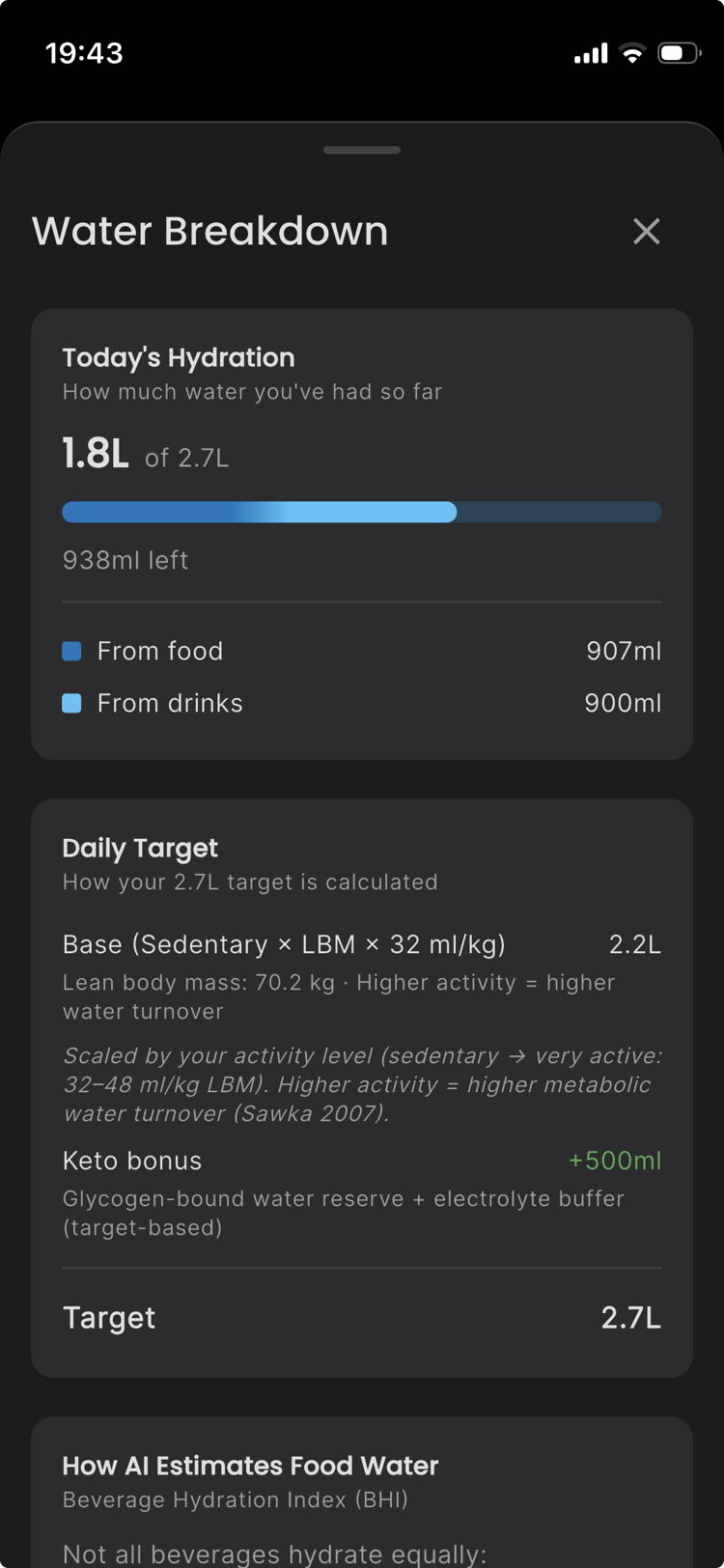
- Automatic water estimation from food — When you log a meal (by photo, voice, or text), AI estimates the water content of every food item. A 200g cucumber contributes ~192ml. A glass of milk contributes more than a glass of water (BHI-adjusted).
- BHI-adjusted beverages — Coffee counts at 1.0×, milk at 1.5×, beer at 0.9×. No more guessing what "counts" toward hydration.
- Personalized daily targets — Your target is calculated from your lean body mass (not total weight), adjusted for your activity level, and includes a keto bonus if your carb target is below 50g.
- Two-tone dashboard bar — Dark blue shows water from food, light blue shows water from drinks. You see your complete hydration picture at a glance.
- Quick manual entry — Tap "Add Water" with presets (250/500/750 ml) for drinks that aren't logged as food.
- HealthKit sync — Water intake is written to Apple Health, so it shows up alongside your other health data.
- Apple Watch support — Log water from your wrist with quick presets. Water complications show daily progress on your watch face.
The dashboard shows a complete picture — no manual glass-counting, no guessing whether coffee counts, no arbitrary 8-glass target.
Practical Takeaways
- Stop counting glasses. Start understanding your total hydration picture — food and drinks combined.
- Coffee and tea count. BHI = 1.0. Stop feeling guilty about your morning coffee — it hydrates you just as well as water.
- Eat your water. Cucumbers, watermelon, yogurt, soups — high-water foods hydrate and nourish.
- Milk is a hydration champion. BHI of 1.5 means a glass of milk retains 50% more fluid than a glass of water.
- On keto: pair water with electrolytes. Plain water alone can worsen electrolyte imbalance. Add sodium, potassium, and magnesium — especially in weeks 1-2.
- Personalize your target. A 60kg sedentary woman and a 100kg active man have very different hydration needs. Use lean body mass, not a one-size-fits-all number.
- Track it automatically. Let AI estimate water from your food so you see the complete picture without extra effort.
FAQ
Sources
- Valtin H. (2002). "Drink at least eight glasses of water a day." Really? Is there scientific evidence for "8 × 8"? American Journal of Physiology. PubMed
- Maughan RJ, Watson P, Cordery PA, et al. (2016). A randomized trial to assess the potential of different beverages to affect hydration status: development of a beverage hydration index. American Journal of Clinical Nutrition. PubMed
- Killer SC, Blannin AK, Jeukendrup AE. (2014). No Evidence of Dehydration with Moderate Daily Coffee Intake. PLoS ONE. PMC
- Gandy J. (2015). Water intake: validity of population assessment and recommendations. European Journal of Nutrition. PMC
- Sawka MN, Burke LM, Eichner ER, et al. (2007). Exercise and Fluid Replacement. Medicine & Science in Sports & Exercise. ACSM Position Stand.
Track Your Hydration — Automatically
Download AI Food Coach and see your complete hydration picture — water from food, BHI-adjusted beverages, and a personalized daily target based on your body.